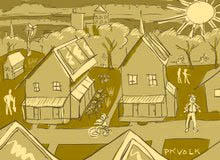
A Neighborhood on Purpose

In our cohousing community members work together to create a socially rich community that is safe, sustainable, diverse, egalitarian, supportive, attractive and affordable.

Members collaborate to plan and develop their own neighborhood. Homes are owned privately but are deliberately clustered to provide a village-like common space that is protected from vehicle traffic. There is also a common house, which typically includes dining, recreation and childcare facilities and other amenities. In our community there is no effort to establish a religious or philosophical creed; what we share is a desire to live more economically, sustainably, and cooperatively.
GreenHavenCohousing.org
Follow greenhavencoho on Twitter
Contact us at info@greenhavencohousing.org

203-903-COHO (2646)

Thursday, April 4, 2013

An evening with the author—save the date, April 28

On Sunday, April 28, Green Haven is sponsoring an evening with Nathanael Johnson. His book is All Natural: A Skeptic's Quest to Discover if the Natural Approach to Diet, Childbirth, the Environment, and Healing Really Makes Us Healthier and Happier.

Snacks and info session 6–7, author discussion 7–9.


Location: The Grove's new location at 760 Chapel Street, New Haven

Big turnout at Bethany P&Z public hearing on zoning change

Here is senior Patch reporter Paul Singley's article on last night's public hearing. Over 300 people attended. Green Haven presented the proposal. Members, Jack Nork, Brenda Caldwell, Charlotte Hitchcock; attorney John Parese; and housing consultant David Berto described the proposal and how the zoning change would affect the town.

A key part of the presentation was a comparison between the type of development that is forced by current zoning regulations and the type that is envisioned by the proposed regulation. Here is a graphic that was shown, using as an example the Meyers Road property Green Haven has an option on.


 Note that the two versions are at the same scale. Click for a larger image.

Town planner Hiram Peck commented on the proposal and suggested some amendments. Then town officials were invited to comment. And finally it was time for the public to comment.

The number of people who signed up to speak far exceeded the time available, so the hearing was adjourned at 10:30 pm and will resume at 7:30 pm on Wednesday, April 17, at the same location—the town gym in Bethany Town Hall.


Monday, April 1, 2013

Questions and answers about the proposed OSHD posted

In March 2013, Green Haven members residing in Bethany, Connecticut, sent residents of Bethany a letter concerning our application for an amendment to the zoning regulation to define an open space housing district (OSHD). In response to that letter, residents posed some questions, listed here with responses from Green Haven. Also see our FAQ page.

Wednesday, March 13, 2013

New York Times article on cohousing

You may need to be a Times subscriber to access the full article . . .

In Retiree Housing, Talking About Multigenerations, March 13, 2013

Saturday, March 2, 2013

Green Haven news release on open space housing district proposed zoning amendment

Bethany, CT—February 12—Green Haven, Inc., a group of area residents, has submitted an application to the Bethany Planning and Zoning Commission to amend the town Zoning Regulations by adding a regulation governing open space housing districts. 


The proposed regulation is consistent with the Bethany Town Plan of Conservation and Development. It provides for flexibility in development of residential property in order to preserve and protect open space and other valuable natural, scenic, historical and man-­made resources; to reduce taxpayer-­supported infrastructure costs; to reduce the extent of impervious surfaces; and to promote development that is environmentally responsible, energy efficient, compatible with surrounding areas and in harmony with natural site features. 

The proposal would enable development of parcels between 20 and 35 acres in such a way that at least half of the land remains open for conservation and agricultural use. It applies low-­‐impact standards with respect to water management and encourages sustainable practices, energy-­‐ efficient design, and the use of renewable energy resources. 

The proposal is sponsored by Green Haven Cohousing, an organization planning a small neighborhood of approximately 25 to 35 homes on a portion of the former Elsie Halter farm at the corner of Old Amity Road and Meyers Road. Green Haven members, some of whom are long-­time Bethany residents, plan to live in the community. They have been working closely with Centerbrook Architects and Appleseed Permaculture to design the development in keeping with Bethany’s rural character and community values. 

Green Haven plans to reestablish agricultural activity at the farm and renovate the Treat Clark farmhouse. A small-­scale diversified organic farming operation on the property will increase biodiversity and help restore the soil, fields and forest to a healthy state, contributing to the health of the West River watershed. Green Haven also intends to work with the Bethany Land Trust to provide public access to the adjacent Spykman Preserve. 

The property was previously approved for a 48-­unit senior affordable housing development that would have filled the entire site with suburban-­style homes, lawns, and driveways. Green Haven’s vision is for a multigenerational community featuring fewer, smaller units clustered around a common building that will house shared amenities, with plenty of open space for community gardens and recreation. The Green Haven group’s intention is to live as sustainably as possible, with a low carbon footprint and low-­impact design. 
Click here to download a PDF copy of the press release.

###

Media Contact:
Jack Nork
Media@greenhavencohousing.org
203-903-COHO (2646)

Monday, February 4, 2013

Learning to live in community


This last weekend Green Haven held a two-day workshop with self-governance guru Diana Leafe Christian, author of Creating a Life Together: Practical Tools to Grow Ecovillages and Intentional Communities. We got a good refresher course in dynamic governance, the consent-based governance model we've adopted, and got into some of the issues we face as our organization transitions from the planning and dreaming stage into actually building, working, and living together.

Dynamic governance (also known as circular organizing, also known as sociocracy) was originally developed in the Netherlands as a way to introduce consent-based decision making into the hierarchy of a business setting, organizing people at every level that are responsible for certain functions or areas of expertise into "circles" that are empowered to make decisions about their work. Each circle is "double linked" to circles at higher or more general levels (in a manufacturing concern that might mean a larger department, on up to a board of directors) and at lower or more specific levels (a small work group that designs widgets, or a cleaning team), with an operating head of each circle taking guidance from a higher circle and a representative from the lower circle reporting back to the higher circle. This structure creates feedback loops so the larger group can function at optimal efficiency.

Simple, right?!? Of course, it all sounds a little odd to our American ears at first, and the jargon might potentially make one suspicious, particularly when we're all accustomed to solving problems through conflict-based dialectical point/counterpoint debate, where ideas basically do battle. But we've been using dynamic governance for the last year or so, and it has really improved how our meetings run, how our committees (which we sometimes call "circles") get work done, and how we think about the big decisions involved with purchasing land, hiring professionals, and designing the built environment of our community. (For a very brief rundown on dynamic governance, check out the Wikipedia page.)


Thursday, January 17, 2013

Registration Now Open

Green Haven Cohousing presents

A Weekend Workshop
February 2 & 3, 2013
9 to 5 each day
Using tools, correcting course,
a look in the mirror
For members, friends, and all those
considering joining our co-housing community
with
and resource guest

Meet a key requirement for Green Haven membership:
 
Training in dynamic governance
 
$145 for the 2-day workshop 
includes lunches, snacks, materials, and
 complimentary childcare
for both younger and older children
$90, for those with no Green Haven intentions, for Saturday only
 
Click here to reserve your spot,
then send check made out to Green Haven, Inc.
Mailing address is on the registration page.

SATURDAY
Fundamentals of Dynamic Governance— Introducing the basics to newcomers, and clarifying any confusion for the rest of us.
Friends Meeting House, 223 East Grand Avenue,New Haven 06513

Open to anyone wanting to learn about this governance and decision-making system
  • Based on efficiency, transparency, and equal access to power
  • Harmonious and productive meetings and committee work 
  • Lead, do, measure--feedback for effective course-correction
SUNDAY:
Course Correction: Self-Governance Process and Green Haven NOW—Beyond the basics—applying these principles to Green Haven’s governance
 NOTE DIFFERENT VENUE: Common Ground High School,358 Springside Avenue, New Haven 06515

The workshop's second day is open to Green Haven Members, and anyone exploring the idea of joining the Green Haven community. Saturday is prerequisite to Sunday. Topics include:
  • Periodically evaluating decisions for effective self-governance
  •  Learning to apply role improvement feedback for greater harmony
  • Working current live Green Haven issues  
 
Diana Leafe Christian is author of Creating a Life Together: Practical Tools to Grow Ecovillages and Intentional Communities, about forming successful communities and ecovillages (now also in French, Italian, Spanish, and Russian), and Finding Community: How to Join an Ecovillage or Intentional Community. Former editor of Communities magazine in the US for 14 years, she now publishes Ecovillages, a free online newsletter http://EcovillageNews.org.
Diana speaks at conferences, does consultations and leads workshops in North America and internationally on the tools and processes that help new and forming communities succeed; on applying sociocracy (aka dynamic governance) to cohousing communities and other intentional communities; and on creating connection and harmony in groups.
As a teacher, Diana has the ability to make complex issues simple and clear. Her knowledge of the many issues of cohousing communities—including their governance issues—gives her the ability to teach dynamic governance with a specific focus on how it can be applied to cohousing. From her deep and broad understanding of group dynamics, she teaches effective and harmonious ways to resolve the group dynamics challenges that can arise in any community.
She lives in an off-grid homesite at Earthaven Ecovillage in North Carolina, http://www.DianaLeafeChristian.org